


Esther's Siblings
Bridget (1770-1829) & Marianne (1776-1828,
Samuel (1778-1787) & Charlotte (1782-1787)
Read about Bridget & John Curtis Byles and their Family.
Childhood Frailty
Esther’s two sisters, Bridget and Marianne, were fortunate to survive infancy, though both were born with physical challenges.
Bridget’s premature birth was precipitated by Marie falling down a flight of stairs. She was a sickly child, completely deaf in one ear and so short-sighted for her first two years that she was thought to be blind. A family story recounts that one bright August morning, when she was about two years old, her aunt placed her on a chair near a window facing east while dressing her. As the morning sun shone full on her face, the child cried out plaintively, “Hurty, aunty, hurty,” rubbing her eyes. From that day forward, her sight gradually improved, and she eventually gained normal vision. Her deafness, however, remained throughout her life.
Six years later, Marianne was born, another delicate child whose parents feared she too might not survive infancy. Though she lived, her childhood was marked by recurring illnesses, including attacks of jaundice and periods of deep melancholy.
Contrasting Temperaments
The sisters differed greatly in temperament and disposition.
Bridget was short and inclined to be plump. She was an early riser, an excellent mother and housekeeper, careful in the management of time, and possessed a cheerful nature marked by a ready laugh. Esther provides insights into the personality and character of Bridget, describing her as being "always alive and awake to the call of duty; always active and prompt in feelings of kindness and deeds of benevolence to all with whom she was connected. Indeed, Esther writes, it may be questioned whether she was ever half an hour in any person's company without devising some plan for doing them good, either in their temporal or their spiritual concerns.
Marianne, by contrast, was shy and retiring, anxious and fearful—traits that closely resembled those of her mother.
A Childhood Shadowed by Loss
During the first six years of Bridget’s life, the household experienced repeated sorrow. Several children were born, and many died in infancy. Before Marianne was born in 1776, three siblings had already died. Two more children died in 1777. The family’s surviving children grew up in the shadow of these losses.
By the time Esther was born in 1786, five children were living. Marianne, then ten years old, and Samuel, eight, were at school; Charlotte was four; and Bridget’s formal schooling had already ended. For a brief time, the family appeared settled and thriving.
This fragile stability was shattered the following year when Samuel and Charlotte died of smallpox in July 1787. Their deaths sent shockwaves through the household.
The Family’s Grief
The grief was overwhelming for the entire family. Their mother Marie, already prone to melancholy, withdrew almost completely. The shock affected her deeply, and she remained a semi-invalid for the rest of her life.
Bridget, at seventeen, was profoundly affected yet continued to function and became a pillar of strength within the household.
Marianne, however, suffered deeply. At eleven years of age, and with her mother emotionally unavailable, she clung closely to Bridget for support.
Marianne’s Early Spiritual Anxiety
The emotional trauma left a deep impression on Marianne. A deeply religious aunt living with the family frequently spoke to her about the dangers of sin and the terrors of hell. Because the two children who had died were younger than she was, Marianne became painfully aware of her own mortality. She began to fear that she, too, might die and be condemned.
She brooded anxiously over what she believed were her sins—minor acts of disobedience, childish stubbornness, losing things, or telling an untruth. Esther later wrote:
“She shrank with horror at the thought of death, and for many months the dread of it overwhelmed her mind. Her constant question was, ‘Will I go to heaven if I die?’”
Over time, as ordinary routines resumed and Marianne began attending the same school Bridget had attended at Mile End, her fears gradually subsided, and she returned to a more cheerful state. Esther later reflected critically on this period, believing that Marianne had dismissed her early religious convictions too lightly.
Esther’s Childhood Understanding of Loss
During Esther’s own childhood, the deaths of Samuel and Charlotte were rarely spoken of. She learned about these siblings from her nurse when she was about five years old, while living in Cheshunt. The nurse described their sayings and doings and the profound grief their deaths had caused.
Esther later recalled imagining she remembered them, though she knew such memories were impossible. She often wept at the thought of having lost them and resolved that if she could be as good as they were, she might become a comfort to her parents.
Marianne’s Religious Life
In 1800, Marianne became a member of the church at Henley. Esther later suggested that she had been “persuaded, or driven into” the decision without fully understanding its significance. Although this allowed her to participate in communion, it did not bring her the peace of mind she sought.
Her outlook changed after the arrival of the Rev. James Churchill in 1807. His preaching emphasised the need for a personal spiritual transformation—what he described as being “born again.” Through his ministry, Marianne found a renewed sense of spiritual assurance and became an enthusiastic participant in the religious meetings and the Sunday school he organised.
Devotion to Family
After Esther married in 1807, Marianne remained at home caring for their parents.
For many years, she had watched her mother gradually decline, and shortly after her death in 1811, their father, Pierre, died suddenly in 1812.
After his death, she moved to Wharf House to live with Bridget. As always, she filled a "role of usefulness" role in the household, caring for young children and handling household tasks. Bridget, in the same year, gave birth to her tenth child, whom she named Pierre Beuzeville Byles in honour of their father—a touching tribute, though sadly the child died at eighteen months of age.
A Final Season with Esther
In 1820, following the death of Esther’s husband James Philip Hewlett, Marianne moved to Oxford to live with Esther and assist with the household.
Five years later, in 1825, the three sisters spent an unusually long time together when Bridget came to Oxford to help care for Esther’s family, as Marianne's illness was causing great consternation. Esther later reflected that it was the longest time they had spent together since her marriage. She remembered it as a period of deep affection and reflection, when the sisters looked back on the many trials and mercies of their lives and felt united in gratitude for God’s providence.
Bridget’s Domestic Anecdote
A small domestic story recorded later by Emma Mary Byles illustrates Bridget’s practical nature. She possessed what was said to be an infallible method for preserving fruit: after bottling it carefully, she buried the bottles in the garden to keep out the air. One year a large supply of fruit was solemnly interred, but when winter came and it was needed, Bridget could not remember where she had buried it. The bottles were never recovered, leaving only a humorous memory of the little housewife’s dismay at the loss of her carefully prepared stores.
Marianne’s Final Illness
Marianne’s health continued to deteriorate in the following years. Painful illness gradually weakened her, and she eventually returned to Henley, where she spent the final stage of her life.
Notes & Sources
The above is a summary using material from Esther's memoir of the latter years of her two sisters, "Memorials of Practical Piety." London: Holdsworth and Ball, 1830 and Emma Mary Byles, "Family Notes", Unpublished, 1926.
Bridget Beuzeville & John Curtis Byles
Marriage and Life at Henley-on-Thames
John Curtis Byles and Bridget Beuzeville were married on 25 October 1796 at Rotherfield Greys, near Henley-on-Thames in Oxfordshire. The ceremony was conducted by the Rev. George Paroissien, and the witnesses—Peter, Marianne, and Elizabeth Beuzeville, along with James Belloncle—reflect the close-knit nature of Bridget’s family and their Huguenot connections.
Life by the River: Trade, Home and Community
Following their marriage, the couple settled in Henley-on-Thames, where John Curtis Byles established himself in a dual occupation: he was both a corn and coal merchant and a wharfinger. In this latter role, he held the right to moor barges along the riverfront near Henley Bridge, where he also maintained a warehouse—later converted into a malt-house during the brewery era. His work placed him at the centre of the town’s commercial life. As a general carrier, he transported corn and timber to London and returned with coal, thus profiting at multiple stages of each journey. This combination of enterprise and opportunity tied his livelihood closely to the rhythms of the River Thames.
The family home, known as Wharf House, stood on the opposite side of Friday Street, near the gate leading to the towing-path toward Shiplake. This detached two-storey house became the setting for much of the family’s early life. It was also the birthplace of William Byles, later the father of Frederick Byles. An incident from William’s infancy became part of family lore: during a severe flood, the Thames overflowed the roadway and swept into the garden. To ensure the child’s safety, he was passed from an upstairs window into a waiting boat. The height of this flood was later marked by a stone in the warehouse, a tangible reminder of the river’s power.
Family Childhood, and the World of the Thames
The Thames itself played a central role in the upbringing of the Byles children. For them, Henley remained an idyllic place long after childhood had passed. The river offered endless recreation—bathing and fishing in summer, skating in winter, and, for some of the sons, more ambitious pursuits. They became skilled oarsmen, at times rowing remarkable distances: upstream past Oxford and Lechlade, through the Thames and Severn Canal and its tunnel to Gloucester, and onward along the Severn and Avon as far as Stratford. Such experiences reflect both the family's physical vitality and the river's importance as a highway of movement and adventure.

John Curtis Byles, though earnest in character, was not without humour. At the table, he would encourage his large family to moderate their appetites with playful ingenuity: “Now, boys, those who eat the most pudding shall have the most meat.” His practical frugality was equally evident. After returning from Sunday morning service, he would exchange his best coat for an older one, explaining to any guest that he had “six reasons” for doing so—his five sons and one daughter. These small glimpses reveal a man attentive to both economy and the well-being of his household. (Image: Ralph Byles, family archives)
John and Bridget had ten children, though several did not survive infancy or early childhood. Among those lost were Ann Margaret (1799–1800), Marianne (1808–1810), Elizabeth (1808–1809), and Peter Beuzeville Byles (1812–1814). These early deaths, so common in the period, must have cast their own quiet shadow over family life, even amid its evident warmth and vitality.
Prosperity and Decline in a Changing Age
In later years, however, John Curtis’s circumstances became more difficult. Financial troubles emerged, as revealed in letters from his brother, James Hodge Byles, a planter in Jamaica. Writing from Bowden Hall in Gloucester in July 1832—the year of the Reform Bill—James attributed the downturn in trade to political agitation and expressed concern for his brother’s position. Although he had previously lent money to support John’s business, he was unable to provide further assistance. Nevertheless, he did not demand repayment and advised John to retain the carrying trade for as long as it could meet his modest needs and allow provision for his “excellent daughter,” Margaret.
There is a certain poignancy in this advice. James, writing from afar, did not fully appreciate the extent to which transport itself was undergoing transformation. Turnpike roads were already reshaping patterns of trade, and the coming of the railways—still unforeseen—would soon render older forms of river-based commerce increasingly obsolete. Thus, the life that John Curtis Byles had built, so firmly rooted in the Thames and its traffic, was gradually overtaken by wider forces of change.
Yet for all these later difficulties, the memory of Henley remained, for his children, a place of richness and freedom—shaped by river, family, and enterprise, and marked by both the joys and uncertainties of life in a changing age.
Notes & Sources
"Family Notes" by Emma Mary Byles, 1926.
Surviving Children of John Curtis and Bridget Byles

Dr Samuel Byles (1799-1856) married Elizabeth Barbet (1798-1875) (distant cousins). Samuel was surgeon to the Hospital or Asylum for poor French Protestants and their Descendants (incorporated in 1718), and to the Guardian Society Asylum, which provided temporary asylum for prostitutes (established 1812). Byles had to attend cases of violent assault, and his name crops up in a number of murder and manslaughter cases heard at the Old Bailey, where he gives key testimony.
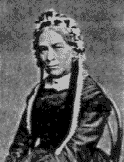
Margaret Byles (1803-1877) was unmarried and the only surviving sister to her five brothers. Her life was largely spent looking after them and their families and the poor. She is described by Fred Byles as being “small in stature and a little shrunken, always dressed to the point of neatness, with an ‘other-worldly’, wistful face”. Margaret returned to Henley towards the end of her life and died there at the age of 74. She was greatly missed.

James Hodge Byles (1806-1877) married Caroline Bent (1799-1945) John commenced a business of chemist and druggist at 86 Hackney Road, Hackney.
It included a post office.
James died at Henley on Thames in 1877. Fred Byles describes his Uncle James as having a white beard and ivory complexion with the face of a patriarch, and a kind and even temperament.

William Byles (1807-1891) married (1) Anna Holden, (2) Jane Dreweatt Bragwin. William Byles had four children with Anna Holden and seven with Jane Bragwin, settled in Bradford and founded the ‘Bradford Observer’ a local newspaper in the Midlands. Mr. Byles's life was indeed one of activity and service to his fellow-men. He has left his mark in Bradford - on its religion, its philanthropy, its educational character, and on its politics. Father Thomas Roussel Byles who died on the ship Titanic was a grandson of William Byles.

Henry Beuzeville Byles (1810-1888) married Mary Holden (1810-1895). About 1810 Henry was apprenticed to Simpkin & Marshall, the London publishers. Later he moved to Bradford and entered into a business partnership with his brother, William. They shared the same premises in Bradford and their relationship was close. Henry had, writes Fred Byles, a quiet disposition, was unvarying in his manner of life, and reserved in conversation.
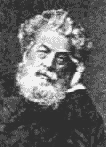
John Beuzeville Byles (1801-1870) married Martha Soundy (1803-1888). John remained in Henley and was heir to his father’s business. He had a large family which carried on the Oxfordshire connection for another generation. Later in life he became a brewer taking over the management of the ‘Friday Street Brewery’ for which he was remunerated with the house attached to the brewery and a salary of 150 pounds per annum.
Notes & Sources
Protos from the library of Ralph Byles.