

Roussel
A French Line Marked by Scholarship, Persecution, and Endurance
The Roussel family forms another key branch of Esther’s ancestry. Known for their connection to the French Reformed Church, the Roussels endured loss, imprisonment, and forced migration during religious persecution. Their legacy is one of resilience, intellectual strength, and deep Protestant conviction.
Essays in This Family Line:
Origins of Esther Hewlett Copley’s Roussel Line
The Roussel family is a significant and recurring strand in Esther Hewlett Copley's ancestry. The name appears in both her maternal and paternal lines, reinforcing a shared Huguenot heritage that shaped the spiritual and intellectual atmosphere of her upbringing.
The surname, of medieval French origin, appears in numerous variant spellings — Russel, Rousel, Rousell, Roussell — and is generally derived from the Old French rous, meaning “red(-haired),” with the diminutive suffix -el. It is well established in Normandy by the thirteenth and fourteenth centuries.
Early documentary records show the presence of prominent ecclesiastical figures bearing the name in Rouen and the surrounding regions. Among them were Jean Roussel, associated with the reconstruction of the Cathedral of Saint-Ouen in the early fourteenth century, and Raoul Roussel (1389–1452), later Archbishop of Rouen, who played a notable role in the ecclesiastical proceedings surrounding the trial of Joan of Arc. While no direct genealogical connection has been established between these men and Esther’s line, their presence demonstrates the name's longstanding presence in Normandy—a region deeply affected by the religious upheavals of the sixteenth century.
The securely documented branches of Esther’s ancestry begin in the late sixteenth century with Pierre Roussel, who married Madeleine Malfrein about 1597, and with their son Laurens Roussel (1599–1677). From this point forward, the line can be traced through the turbulent decades of the French Reformation and its aftermath. It was through successive generations descending from this period that the Roussel heritage entered both the Beuzeville and Hewlett families, ultimately converging in Esther herself.
The Reforming Roussels and Hewlett’s Pedigree
Rev. James Philip Hewlett II devoted careful attention to the earlier history of the Roussel name in his scholarly pedigree chart of the family’s French ancestry. In that document, he wrote:
“Gérard and Arnaud Roussel were intimate friends of Farel and Briçonnet, the celebrated French Reformers. Early in the sixteenth century Farel and the two Roussels were spiritual instructors of Marguerite of Valois, afterwards Queen of Navarre. She chose for her emblem the Aster — a flower first seen in the garden of one of the Roussels — with the motto non inferiora secutus, the sun being a sun-turning flower also known as the Queen Marguerite and much cultivated by the French Protestants. From one of the brothers Roussel (probably Arnaud) we are descended.”
Hewlett’s interest centred particularly on Father Gérard Roussel (1500–1550) of La Vacquerie, an early reforming cleric associated with the evangelical currents that preceded the formal establishment of Protestantism in France, and on his brother Antoine (Arnaud) Roussel.
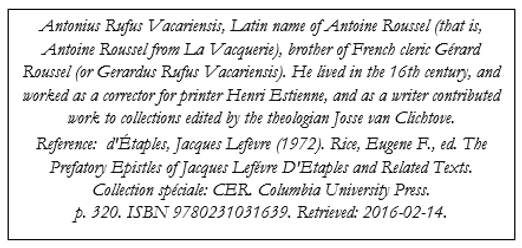
Modern scholarship confirms that Antoine Roussel — also known in Latin as Antonius Rufus Vacariensis (Antoine Roussel of La Vacquerie) — lived in the sixteenth century, worked as a corrector for the printer Henri Estienne, and contributed writings to theological collections edited by Josse van Clichtove. These details support Hewlett’s identification of the historical figures themselves.
However, while records confirm that Gérard Roussel had a brother, Arnaud (Antoine), no documentary evidence has yet been identified linking these brothers directly to the earliest securely documented ancestor in Esther’s line. Hewlett’s conclusion — that descent likely proceeded from Arnaud — remains a considered historical hypothesis rather than a proven genealogical connection.
Nevertheless, the discussion is historically meaningful. It reveals Hewlett’s determination to situate the family within the broader religious transformations of sixteenth-century France, interpreting ancestry not merely as a succession of names but as participation in reforming currents that would later define the Huguenot identity.
The Established Line
The earliest firmly documented ancestor in Esther Hewlett Copley’s Roussel line is Pierre Roussel, who married Madeleine Malfrein about 1597. Through their son Laurens Roussel (1599–1677), the lineage becomes securely traceable through the decades in which the French Reformed Church struggled under increasing repression.
By the time of the Revocation of the Edict of Nantes in 1685, members of the Roussel family were among those who endured imprisonment, loss of property, and forced displacement for adherence to the Reformed faith. Subsequent generations migrated to England, where records of the French Protestant Church in Threadneedle Street, London, preserve baptisms, marriages, and evidence of reconstructed community life.
Through intermarriage among Huguenot families in England — including the Beuzeville line — the Roussel name reappeared on both sides of Esther’s family tree. What she inherited was therefore not merely a distant ancestral surname, but a double legacy marked by:
-
Protestant conviction and reforming impulse
-
endurance under persecution
-
intellectual seriousness
-
disciplined record-keeping
-
and transnational migration
In tracing these origins, Rev. James Philip Hewlett II did more than preserve names and dates. He sought to understand the moral and spiritual continuity of the family across centuries of upheaval. Whether or not every proposed connection can be historically verified, that interpretive seriousness forms part of the intellectual culture into which Esther was born.
Sources & References
-
Rev. James Philip Hewlett II, unpublished pedigree chart.
-
Records of the French Protestant Church, Threadneedle Street, London.
-
Jacques Lefèvre d’Étaples, Le Profayt Epistles (reference confirming Antoine Roussel).
A Note on Sources and Method
The historical essays on this website draw upon research undertaken over many years into the religious and genealogical background of our Huguenot ancestors. The material reflects a combination of nineteenth-century Protestant histories, biographical studies, genealogical works, and modern reference sources.
Some sections originated in earlier privately published research, "A Still Point", and have been adapted here for accessibility. While not every statement is individually footnoted, care has been taken to represent the historical record responsibly and in good faith.
Where significant variations in dates or interpretation exist, these are occasionally noted. Readers wishing to pursue academic study are encouraged to consult primary sources and modern scholarly works on the French Reformation.
This website is intended primarily as a historical and theological exploration for descendants and interested readers, rather than as a critical academic monograp